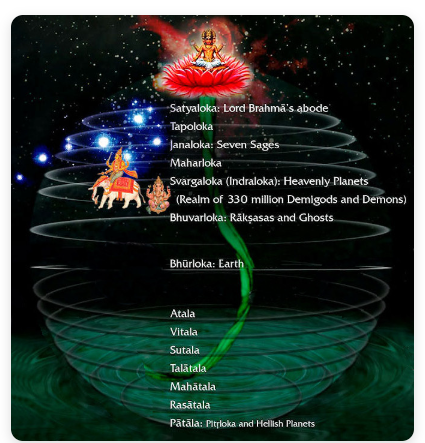
SB 10.14.2
Devanāgarī
अस्यापि देव वपुषो मदनुग्रहस्य स्वेच्छामयस्य न तु भूतमयस्य कोऽपि । नेशे महि त्ववसितुं मनसान्तरेण साक्षात्तवैव किमुतात्मसुखानुभूते: ॥ २ ॥
Text
asyāpi deva vapuṣo mad-anugrahasya svecchā-mayasya na tu bhūta-mayasya ko ’pi neśe mahi tv avasituṁ manasāntareṇa sākṣāt tavaiva kim utātma-sukhānubhūteḥ
Synonyms
asya—of this;api—even;deva—O Lord;vapuṣaḥ—the body;mat-anugrahasya—which has shown mercy to me;sva-icchā-mayasya—which appears in response to the desires of Your pure devotees;na—not;tu—on the other hand;bhūta-mayasya—a product of matter;kaḥ—Brahmā;api—even;naīśe—I am not able;mahi—the potency;tu—indeed;avasitum—to estimate;manasā—with my mind;antareṇa—which is controlled and withdrawn;sākṣāt—directly;tava—Your;eva—indeed;kimuta—what to speak;ātma—within Yourself;sukha—of happiness;anubhūteḥ—of Your experience.
Translation
My dear Lord, neither I nor anyone else can estimate the potency of this transcendental body of Yours, which has shown such mercy to me and which appears just to fulfill the desires of Your pure devotees. Although my mind is completely withdrawn from material affairs, I cannot understand Your personal form. How, then, could I possibly understand the happiness You experience within Yourself?
Purport
When Brahmā disrespected the supreme status of the Personality of Godhead, Lord Kṛṣṇa first bewildered him by exhibiting the Lord’s own transcendental power. Then, having humbled His devotee Brahmā, Kṛṣṇa gave him His personal audience.
According to Śrīla Viśvanātha Cakravartī Ṭhākura, Lord Kṛṣṇa’s transcendental body can also function through the agency of His plenary expansions, called viṣṇu-tattva. As stated by Brahmā himself in the Brahma-saṁhitā (5.32) : aṅgāni yasya sakalendriya-vṛttimanti. This verse indicates not only that the Lord can perform any bodily function with any of His limbs but also that He can see through the eyes of His Viṣṇu expansions or, indeed, through the eyes of any living entity, and similarly that He can hear through the ears of any Viṣṇu or jīva expansion. Śrīla Viśvanātha Cakravartī Ṭhākura points out that although the Lord can perform any function with any one of His senses, in His transcendental pastimes as Śrī Kṛṣṇa He generally sees with His eyes, touches with His hands, hears with His ears and so on. Thus He behaves like the most beautiful and charming young cowherd boy.
The Vedic knowledge expands from Lord Brahmā, who is described in the first verse of Śrīmad-Bhāgavatam as ādi-kavi, the primeval Vedic scholar. Yet Brahmā could not understand the transcendental body of Lord Kṛṣṇa, because it is beyond the reach of ordinary Vedic knowledge. Among all the transcendental forms of the Lord, the two-armed form of Govinda — Kṛṣṇa — is original and supreme. Thus Lord Govinda’s pastimes of stealing butter, drinking the gopīs’ breast milk, tending the calves, playing His flute and playing childhood sports are extraordinary even in comparison with the activities of the Lord’s Viṣṇu expansions.