SB 10.3.27
Devanāgarī
मर्त्यो मृत्युव्यालभीत: पलायन् लोकान् सर्वान्निर्भयं नाध्यगच्छत् । त्वत्पादाब्जं प्राप्य यदृच्छयाद्य सुस्थ: शेते मृत्युरस्मादपैति ॥ २७ ॥
Text
martyo mṛtyu-vyāla-bhītaḥ palāyan lokān sarvān nirbhayaṁ nādhyagacchat tvat pādābjaṁ prāpya yadṛcchayādya susthaḥ śete mṛtyur asmād apaiti
Synonyms
martyaḥ—the living entities who are sure to die;mṛtyu-vyāla-bhītaḥ—afraid of the serpent of death;palāyan—running (as soon as a serpent is seen, everyone runs away, fearing immediate death);lokān—to the different planets;sarvān—all;nirbhayam—fearlessness;naadhyagacchat—do not obtain;tvat-pāda-abjam—of Your lotus feet;prāpya—obtaining the shelter;yadṛcchayā—by chance, by the mercy of Your Lordship and Your representative, the spiritual master (guru-kṛpā, kṛṣṇa-kṛpā);adya—presently;su-sthaḥ—being undisturbed and mentally composed;śete—are sleeping;mṛtyuḥ—death;asmāt—from those persons;apaiti—flees.
Translation
No one in this material world has become free from the four principles birth, death, old age and disease, even by fleeing to various planets. But now that You have appeared, My Lord, death is fleeing in fear of You, and the living entities, having obtained shelter at Your lotus feet by Your mercy, are sleeping in full mental peace.
Purport
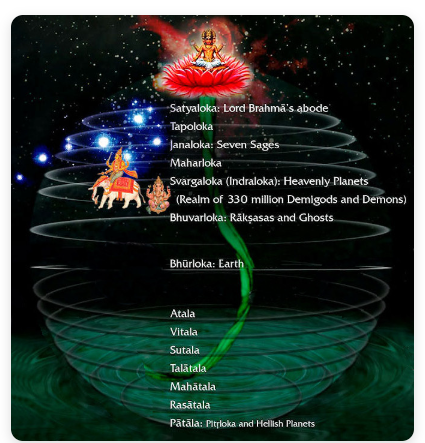
The constitutional position for the living entity is eternity ( na hanyate hanyamāne śarīre, nityaḥ śāśvato ’yam ). Every living entity is eternal. But because of having fallen into this material world, one wanders within the universe, continually changing from one body to another. Caitanya Mahāprabhu says:
brahmāṇḍa bhramite kona bhāgyavān jīva guru-kṛṣṇa-prasāde pāya bhakti-latā-bīja
(Cc. Madhya 19.151)
Everyone is wandering up and down within this universe, but one who is sufficiently fortunate comes in contact with Kṛṣṇa consciousness, by the mercy of the spiritual master, and takes to the path of devotional service. Then one is assured of eternal life, with no fear of death. When Kṛṣṇa appears, everyone is freed from fear of death, yet Devakī felt, “We are still afraid of Kaṁsa, although You have appeared as our son.” She was more or less bewildered as to why this should be so, and she appealed to the Lord to free her and Vasudeva from this fear.
In this connection, it may be noted that the moon is one of the heavenly planets. From the Vedic literature we understand that one who goes to the moon receives a life with a duration of ten thousand years in which to enjoy the fruits of pious activities. If our so-called scientists are going to the moon, why should they come back here? We must conclude without a doubt that they have never gone to the moon. To go to the moon, one must have the qualification of pious activities. Then one may go there and live. If one has gone to the moon, why should he return to this planet, where life is of a very short duration?