SB 3.9.16
Devanāgarī
यो वा अहं च गिरिशश्च विभु: स्वयं च स्थित्युद्भवप्रलयहेतव आत्ममूलम् । भित्त्वा त्रिपाद्ववृध एक उरुप्ररोह- स्तस्मै नमो भगवते भुवनद्रुमाय ॥ १६ ॥
Text
yo vā ahaṁ ca giriśaś ca vibhuḥ svayaṁ ca sthity-udbhava-pralaya-hetava ātma-mūlam bhittvā tri-pād vavṛdha eka uru-prarohas tasmai namo bhagavate bhuvana-drumāya
Synonyms
yaḥ—one who;vai—certainly;ahamca—also I;giriśaḥca—also Śiva;vibhuḥ—the Almighty;svayam—personality (as Viṣṇu);ca—and;sthiti—maintenance;udbhava—creation;pralaya—dissolution;hetavaḥ—the causes;ātma-mūlam—self-rooted;bhittvā—having penetrated;tri-pāt—three trunks;vavṛdhe—grew;ekaḥ—one without a second;uru—many;prarohaḥ—branches;tasmai—unto Him;namaḥ—obeisances;bhagavate—unto the Personality of Godhead;bhuvana-drumāya—unto the tree of the planetary system.
Translation
Your Lordship is the prime root of the tree of the planetary systems. This tree has grown by first penetrating the material nature in three trunks — as me, Śiva and You, the Almighty — for creation, maintenance and dissolution, and we three have grown with many branches. Therefore I offer my obeisances unto You, the tree of the cosmic manifestation.
Purport
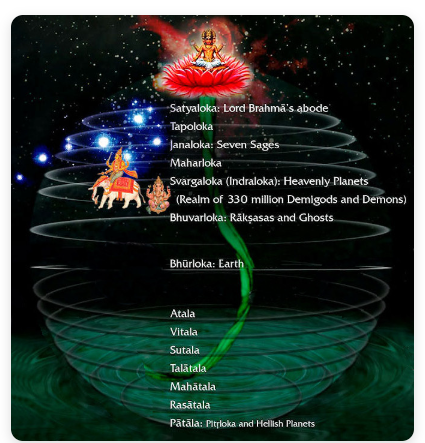
Due to a poor fund of knowledge, the impersonalist does not believe in the personal management of things as they are. But in this verse it is clearly explained that everything is personal and nothing is impersonal. We have already discussed this point in the Introduction, and it is confirmed here in this verse. The tree of the material manifestation is described in the Fifteenth Chapter of Bhagavad-gītā as an aśvattha tree whose root is upward. We have actual experience of such a tree when we see the shadow of a tree on the bank of a reservoir of water. The reflection of the tree on the water appears to hang down from its upward roots. The tree of creation described here is only a shadow of the reality which is Parabrahman, Viṣṇu. In the internal potency manifested in the Vaikuṇṭhalokas, the actual tree exists, and the tree reflected in the material nature is only the shadow of this actual tree. The impersonalists’ theory that Brahman is void of all variegatedness is false because the shadow-tree described in Bhagavad-gītā cannot exist without being the reflection of a real tree. The real tree is situated in the eternal existence of spiritual nature, full of transcendental varieties, and Lord Viṣṇu is the root of that tree also. The root is the same — the Lord — both for the real tree and the false, but the false tree is only the perverted reflection of the real tree. The Lord, being the real tree, is here offered obeisances by Brahmā on his own behalf and also on behalf of Lord Śiva.