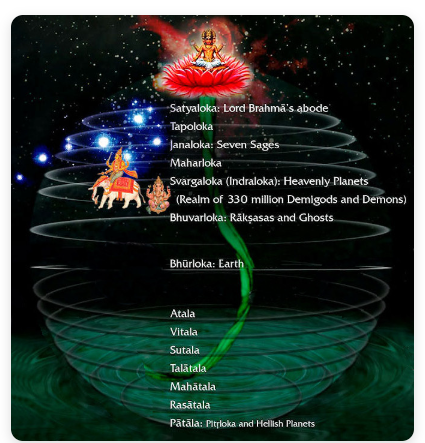
SB 4.21.42
Devanāgarī
यद्ब्रह्म नित्यं विरजं सनातनं श्रद्धातपोमङ्गलमौनसंयमै: । समाधिना बिभ्रति हार्थदृष्टये यत्रेदमादर्श इवावभासते ॥ ४२ ॥
Text
yad brahma nityaṁ virajaṁ sanātanaṁ śraddhā-tapo-maṅgala-mauna-saṁyamaiḥ samādhinā bibhrati hārtha-dṛṣṭaye yatredam ādarśa ivāvabhāsate
Synonyms
yat—that which;brahma—the brahminical culture;nityam—eternally;virajam—without contamination;sanātanam—without beginning;śraddhā—faith;tapaḥ—austerity;maṅgala—auspicious;mauna—silence;saṁyamaiḥ—controlling the mind and senses;samādhinā—with full concentration;bibhrati—illuminates;ha—as he did it;artha—the real purpose of theVedas;dṛṣṭaye—for the purpose of finding out;yatra—wherein;idam—all this;ādarśe—in a mirror;iva—like;avabhāsate—manifests.
Translation
In brahminical culture a brāhmaṇa’s transcendental position is eternally maintained because the injunctions of the Vedas are accepted with faith, austerity, scriptural conclusions, full sense and mind control, and meditation. In this way the real goal of life is illuminated, just as one’s face is fully reflected in a clear mirror.
Purport
māṁ ca yo ’vyabhicāreṇa bhakti-yogena sevate sa guṇān samatītyaitān brahma-bhūyāya kalpate
“One who engages in full devotional service and who does not fall down in any circumstance at once transcends the modes of material nature and thus comes to the level of Brahman.”
Therefore a devotee of Lord Kṛṣṇa is actually a perfect brāhmaṇa. His situation is transcendental, for he is free from the four defects of conditional life, which are the tendencies to commit mistakes, to be illusioned, to cheat and to possess imperfect senses. A perfect Vaiṣṇava, or Kṛṣṇa conscious person, is always in this transcendental position because he speaks according to Kṛṣṇa and His representative. Because Vaiṣṇavas speak exactly according to the tune of Kṛṣṇa, whatever they say is free from these four defects. For example, Kṛṣṇa says in Bhagavad-gītā that everyone should always think of Him, everyone should become His devotee, offer Him obeisances and worship Him, and ultimately everyone should surrender unto Him. These devotional activities are transcendental and free from mistakes, illusion, cheating and imperfection. Therefore anyone who is a sincere devotee of Lord Kṛṣṇa and who preaches this cult, speaking only on the basis of Kṛṣṇa’s instructions, is understood to be virajam, or free from the defects of material contamination. A genuine brāhmaṇa or Vaiṣṇava therefore depends eternally on the conclusion of the Vedas or Vedic versions presented by the Supreme Personality of Godhead Himself. Only from Vedic knowledge can we understand the actual position of the Absolute Truth, who, as described in Śrīmad-Bhāgavatam, is manifested in three features — namely impersonal Brahman, localized Paramātmā and, at last, the Supreme Personality of Godhead. This knowledge is perfect from time immemorial, and the brahminical or Vaiṣṇava culture depends on this principle eternally. One should therefore study the Vedas with faith, not only for one’s personal knowledge, but for the sake of spreading this knowledge and these activities through real faith in the words of the Supreme Personality of Godhead and the Vedas.
In this verse the word maṅgala, “auspicious,” is very significant. Śrīla Śrīdhara Svāmī quotes that to do what is good and to reject what is not good is called maṅgala, or auspicious. To do what is good means to accept everything favorable to the discharge of devotional service, and to reject what is not good means to reject everything not favorable for discharging devotional service. In our Kṛṣṇa consciousness movement, we accept this principle by rejecting four prohibited items — namely illicit sex life, intoxication, gambling and flesh-eating — and accepting the daily chanting of at least sixteen rounds of the Hare Kṛṣṇa mahā-mantra and meditation three times a day by chanting the Gāyatrī mantra. In this way one can keep his brahminical culture and spiritual strength intact. By following these principles of devotional service strictly, chanting twenty-four hours a day the mahā-mantra — Hare Kṛṣṇa, Hare Kṛṣṇa, Kṛṣṇa Kṛṣṇa, Hare Hare/ Hare Rāma, Hare Rāma, Rāma Rāma, Hare Hare — one makes positive progress in spiritual life and ultimately becomes completely fit to see the Supreme Personality of Godhead face to face. Because the ultimate goal of studying or understanding the Vedic knowledge is to find Kṛṣṇa, one who follows the Vedic principles as described above can from the very beginning see all the features of Lord Kṛṣṇa, the Absolute Truth, very distinctly, as one can see one’s own face completely reflected in a clear mirror. The conclusion is, therefore, that a brāhmaṇa does not become a brāhmaṇa simply because he is a living entity or is born in a brāhmaṇa family; he must possess all the qualities mentioned in the śāstras and practice the brahminical principles in his life. Thus he ultimately becomes a fully Kṛṣṇa conscious person and can understand what Kṛṣṇa is. How a devotee continuously sees Kṛṣṇa face to face within his heart is described in the Brahma-saṁhitā (5.38) as follows:
premāñjana-cchurita-bhakti-vilocanena santaḥ sadaiva hṛdayeṣu vilokayanti yaṁ śyāmasundaram acintya-guṇa-svarūpaṁ govindam ādi-puruṣaṁ tam ahaṁ bhajāmi
The devotee, by development of pure love for Kṛṣṇa, constantly sees the Supreme Personality of Godhead, who is known as Śyāmasundara, within his heart. That is the perfectional stage of brahminical culture.