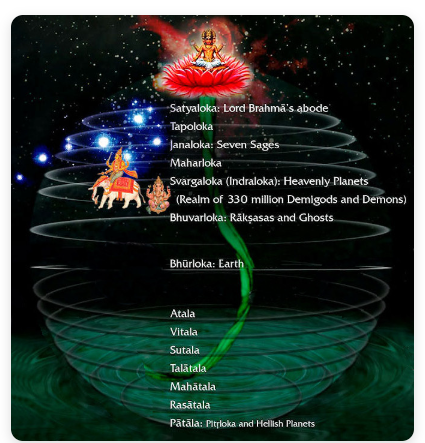
SB 5.17.11
Devanāgarī
तत्रापि भारतमेव वर्षं कर्मक्षेत्रमन्यान्यष्ट वर्षाणि स्वर्गिणां पुण्यशेषोपभोगस्थानानि भौमानि स्वर्गपदानि व्यपदिशन्ति ॥ ११ ॥
Text
tatrāpi bhāratam eva varṣaṁ karma-kṣetram anyāny aṣṭa varṣāṇi svargiṇāṁ puṇya-śeṣopabhoga-sthānāni bhaumāni svarga-padāni vyapadiśanti.
Synonyms
tatraapi—out of all of them;bhāratam—known as Bhārata-varṣa;eva—certainly;varṣam—the tract of land;karma-kṣetram—the field of activities;anyāni—the others;aṣṭavarṣāṇi—eight tracts of land;svargiṇām—of the living entities elevated to the heavenly planets by extraordinary pious activities;puṇya—of the results of pious activities;śeṣa—of the remainder;upabhoga-sthānāni—the places for material enjoyment;bhaumānisvarga-padāni—as the heavenly places on earth;vyapadiśanti—they designate.
Translation
Among the nine varṣas, the tract of land known as Bhārata-varṣa is understood to be the field of fruitive activities. Learned scholars and saintly persons declare the other eight varṣas to be meant for very highly elevated pious persons. After returning from the heavenly planets, they enjoy the remaining results of their pious activities in these eight earthly varṣas.
Purport
ei rūpe brahmāṇḍa bhramite kona bhāgyavān jīva guru-kṛṣṇa-prasāde pāya bhakti-latā-bīja
Among all the living entities wandering throughout the universe, one who is most fortunate comes in contact with a representative of the Supreme Personality of Godhead and thus gets the opportunity to execute devotional service.
Those who are sincerely seeking the favor of Kṛṣṇa come in contact with a guru, a bona fide representative of Kṛṣṇa. The Māyāvādīs indulging in mental speculation and the karmīs desiring the results of their actions cannot become gurus. A guru must be a direct representative of Kṛṣṇa who distributes the instructions of Kṛṣṇa without any change. Thus only the most fortunate persons come in contact with the guru. As confirmed in the Vedic literatures, tad-vijñānārthaṁ sa gurum evābhigacchet: one has to search out a guru to understand the affairs of the spiritual world. Śrīmad-Bhāgavatam also confirms this point. Tasmād guruṁ prapadyeta jijñāsuḥ śreya uttamam: one who is very interested in understanding the activities in the spiritual world must search out a guru — a bona fide representative of Kṛṣṇa. From all angles of vision, therefore, the word guru is especially meant for the bona fide representative of Kṛṣṇa and no one else. Padma Purāṇa states, avaiṣṇavo gurur na syāt: one who is not a Vaiṣṇava, or who is not a representative of Kṛṣṇa, cannot be a guru. Even the most qualified brāhmaṇa cannot become a guru if he is not a representative of Kṛṣṇa. Brāhmaṇas are supposed to acquire six kinds of auspicious qualifications: they become very learned scholars ( paṭhana ) and very qualified teachers ( pāṭhana ); they become expert in worshiping the Lord or the demigods ( yajana ), and they teach others how to execute this worship ( yājana ); they qualify themselves as bona fide persons to receive alms from others ( pratigraha ), and they distribute the wealth in charity ( dāna ). Yet even a brāhmaṇa possessing these qualifications cannot become a guru unless he is the representative of Kṛṣṇa ( gurur na syāt ). Vaiṣṇavaḥ śva-paco guruḥ: but a Vaiṣṇava, a bona fide representative of the Supreme Personality of Godhead, Viṣṇu, can become a guru even if he is śva-paca, a member of a family of dog-eaters. Of the three divisions of heavenly planets ( svarga-loka ), bhauma-svarga is sometimes accepted as the tract of land in Bhārata-varṣa known as Kashmir. In this region there are certainly good facilities for material sense enjoyment, but this is not the business of a pure transcendentalist. Rūpa Gosvāmī describes the engagement of a pure transcendentalist as follows:
anyābhilāṣitā-śūnyaṁ jñāna-karmādy-anāvṛtam ānukūlyena kṛṣṇānu- śīlanaṁ bhaktir uttamā
“One should render transcendental loving service to the Supreme Lord Kṛṣṇa favorably and without desire for material profit or gain through fruitive activities or philosophical speculation. That is called pure devotional service.” Those who fully engage in devotional service to Kṛṣṇa just to please Him are not interested in the three divisions of heavenly places, namely, divya-svarga, bhauma-svarga and bila-svarga.