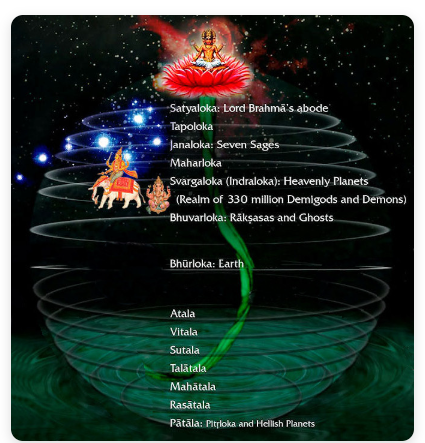
SB 1.16.20
Devanāgarī
पादैर्न्यूनं शोचसि मैकपाद- मात्मानं वा वृषलैर्भोक्ष्यमाणम् । आहो सुरादीन् हृतयज्ञभागान् प्रजा उत स्विन्मघवत्यवर्षति ॥ २० ॥
Text
pādair nyūnaṁ śocasi maika-pādam ātmānaṁ vā vṛṣalair bhokṣyamāṇam āho surādīn hṛta-yajña-bhāgān prajā uta svin maghavaty avarṣati
Synonyms
pādaiḥ—by three legs;nyūnam—diminished;śocasi—if you are lamenting for that;mā—my;eka-pādam—only one leg;ātmānam—own body;vā—or;vṛṣalaiḥ—by the unlawful meat-eaters;bhokṣyamāṇam—to be exploited;āhoḥ—in sacrifice;sura-ādīn—the authorized demigods;hṛta-yajña—devoid of sacrificial;bhāgān—share;prajāḥ—the living beings;uta—increasing;svit—whether;maghavati—in famine and scarcity;avarṣati—because of rainlessness.
Translation
I have lost my three legs and am now standing on one only. Are you lamenting for my state of existence? Or are you in great anxiety because henceforward the unlawful meat-eaters will exploit you? Or are you in a sorry plight because the demigods are now bereft of their share of sacrificial offerings because no sacrifices are being performed at present? Or are you grieving for living beings because of their sufferings due to famine and drought?
Purport
The meat-eaters are generally called mlecchas. But all meat-eaters are not mlecchas. Those who accept meat in terms of scriptural injunctions are not mlecchas, but those who accept meat without restriction are called mlecchas. Beef is forbidden in the scriptures, and the bulls and cows are offered special protection by followers of the Vedas. But in this Age of Kali, people will exploit the body of the bull and the cow as they like, and thus they will invite sufferings of various types.
The people of this age will not perform any sacrifice. The mleccha population will care very little for performances of sacrifices, although performance of sacrifice is essential for persons who are materially engaged in sense enjoyment. In the Bhagavad-gītā (3.14-16)performance of sacrifices is strongly recommended.
The living beings are created by the creator Brahmā, and just to maintain the created living being progressively towards the path back to Godhead, the system of performing sacrifice is also created by him. The system is that living beings live on the produce of grains and vegetables, and by eating such foodstuff they get vital power of the body in the shape of blood and semen, and from blood and semen one living being is able to create other living beings. But the production of grains, grass, etc., becomes possible by rain, and this rain is made to shower properly by performance of recommended sacrifices. Such sacrifices are directed by the rites of the Vedas, namely Sāma, Yajur, Ṛg and Atharva. In the Manu-smṛti it is recommended that by offerings of sacrifice on the altar of the fire, the sun-god is pleased. When the sun-god is pleased, he properly collects water from the sea, and thus sufficient clouds collect on the horizon and rains fall. After sufficient rains fall, there is sufficient production of grains for men and all animals, and thus there is energy in the living being for progressive activity. The mlecchas, however, make plans to install slaughterhouses for killing bulls and cows along with other animals, thinking that they will prosper by increasing the number of factories and live on animal food without caring for performance of sacrifices and production of grains. But they must know that even for the animals they must produce grass and vegetables, otherwise the animals cannot live. And to produce grass for the animals, they require sufficient rains. Therefore they have to depend ultimately on the mercy of the demigods like the sun-god, Indra and Candra, and such demigods must be satisfied by performances of sacrifice.
This material world is a sort of prison house, as we have several times mentioned. The demigods are the servants of the Lord who see to the proper upkeep of the prison house. These demigods want to see that the rebel living beings, who want to survive faithlessly, are gradually turned towards the supreme power of the Lord. Therefore, the system of offering sacrifice is recommended in the scriptures.
The materialistic men want to work hard and enjoy fruitive results for sense enjoyment. Thus they are committing many types of sins at every step of life. Those, however, who are consciously engaged in the devotional service of the Lord are transcendental to all varieties of sin and virtue. Their activities are free from the contamination of the three modes of material nature. For the devotees there is no need for performance of prescribed sacrifices because the very life of the devotee is a symbol of sacrifice. But persons who are engaged in fruitive activities for sense enjoyment must perform the prescribed sacrifices because that is the only means to get free from the reaction of all sins committed by fruitive workers. Sacrifice is the means for counteracting such accumulated sins. The demigods are pleased when such sacrifices are performed, just as prison officers are satisfied when the prisoners are turned into obedient subjects. Lord Caitanya, however, has recommended only one yajña, or sacrifice, called the saṅkīrtana-yajña, the chanting of Hare Kṛṣṇa, in which everyone can take part. Thus both devotees and fruitive workers can derive equal benefit from the performances of saṅkīrtana-yajña.