SB 4.11.5
Devanāgarī
स तान् पृषत्कैरभिधावतो मृधे निकृत्तबाहूरुशिरोधरोदरान् । निनाय लोकं परमर्कमण्डलं व्रजन्ति निर्भिद्य यमूर्ध्वरेतस: ॥ ५ ॥
Text
sa tān pṛṣatkair abhidhāvato mṛdhe nikṛtta-bāhūru-śirodharodarān nināya lokaṁ param arka-maṇḍalaṁ vrajanti nirbhidya yam ūrdhva-retasaḥ
Synonyms
saḥ—he (Dhruva Mahārāja);tān—all the Yakṣas;pṛṣatkaiḥ—by his arrows;abhidhāvataḥ—coming forward;mṛdhe—in the battlefield;nikṛtta—being separated;bāhu—arms;ūru—thighs;śiraḥ-dhara—necks;udarān—and bellies;nināya—delivered;lokam—to the planet;param—supreme;arka-maṇḍalam—the sun globe;vrajanti—go;nirbhidya—piercing;yam—to which;ūrdhva-retasaḥ—those who do not discharge semen at any time.
Translation
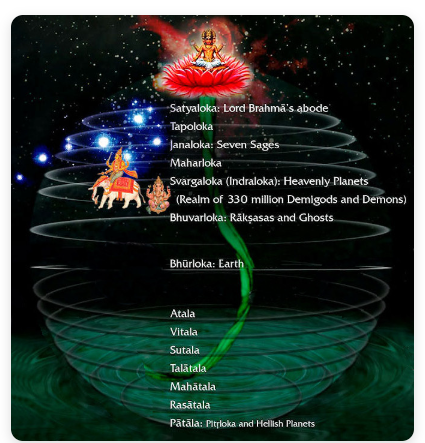
When Dhruva Mahārāja saw the Yakṣas coming forward, he immediately took his arrows and cut the enemies to pieces. Separating their arms, legs, heads and bellies from their bodies, he delivered the Yakṣas to the planetary system which is situated above the sun globe and which is attainable only by first-class brahmacārīs, who have never discharged their semen.
Purport
An important word in this verse is ūrdhva-retasaḥ, which means brahmacārīs who have never discharged semen. Celibacy is so important that even though one does not undergo any austerities, penances or ritualistic ceremonies prescribed in the Vedas, if one simply keeps himself a pure brahmacārī, not discharging his semen, the result is that after death he goes to the Satyaloka. Generally, sex life is the cause of all miseries in the material world. In the Vedic civilization sex life is restricted in various ways. Out of the whole population of the social structure, only the gṛhasthas are allowed restricted sex life. All others refrain from sex. The people of this age especially do not know the value of not discharging semen. As such, they are variously entangled with material qualities and suffer an existence of struggle only. The word ūrdhva-retasaḥ especially indicates the Māyāvādī sannyāsīs, who undergo strict principles of austerity. But in the Bhagavad-gītā (8.16) the Lord says that even if one goes up to Brahmaloka, he again comes back ( ābrahma-bhuvanāl lokāḥ punar āvartino ’rjuna ). Therefore actual mukti, or liberation, can be attained only by devotional service, because by devotional service one can go above Brahmaloka, or to the spiritual world, wherefrom he never comes back. Māyāvādī sannyāsīs are very proud of becoming liberated, but actual liberation is not possible unless one is in touch with the Supreme Lord in devotional service. It is said, hariṁ vinā na mṛtiṁ taranti: without Kṛṣṇa’s mercy, no one can have liberation.