SB 5.1.7
Devanāgarī
अथ ह भगवानादिदेव एतस्य गुणविसर्गस्य परिबृंहणानुध्यानव्यवसित सकलजगदभिप्राय आत्मयोनिरखिलनिगमनिजगणपरिवेष्टित: स्वभवनादवततार ॥ ७ ॥
Text
atha ha bhagavān ādi-deva etasya guṇa-visargasya paribṛṁhaṇānudhyāna-vyavasita-sakala-jagad-abhiprāya ātma-yonir akhila-nigama-nija-gaṇa-pariveṣṭitaḥ sva-bhavanād avatatāra.
Synonyms
atha—thus;ha—indeed;bhagavān—the most powerful;ādi-devaḥ—the first demigod;etasya—of this universe;guṇa-visargasya—the creation of the three modes of material nature;paribṛṁhaṇa—the welfare;anudhyāna—always thinking of;vyavasita—known;sakala—whole;jagat—of the universe;abhiprāyaḥ—by whom the ultimate purpose;ātma—the Supreme Self;yoniḥ—whose source of birth;akhila—all;nigama—by theVedas;nija-gaṇa—by personal associates;pariveṣṭitaḥ—being surrounded;sva-bhavanāt—from his own abode;avatatāra—descended.
Translation
Śrī Śukadeva Gosvāmī continued: The first created being and most powerful demigod in this universe is Lord Brahmā, who is always responsible for developing universal affairs. Born directly from the Supreme Personality of Godhead, he dedicates his activities to the welfare of the entire universe, for he knows the purpose of the universal creation. This supremely powerful Lord Brahmā, accompanied by his associates and the personified Vedas, left his own abode in the highest planetary system and descended to the place of Prince Priyavrata’s meditation.
Purport
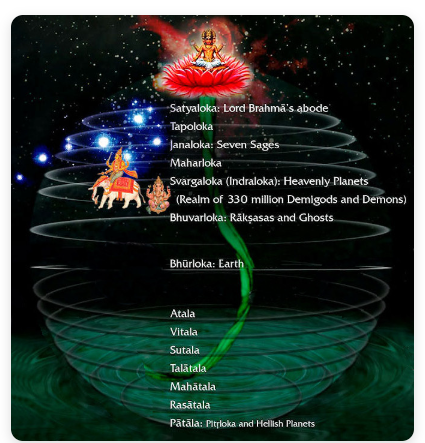
Vedic knowledge is divided into two parts: pravṛtti-mārga and nivṛtti-mārga. Nivṛtti-mārga is the path of negating sense enjoyment, and pravṛtti-mārga is the path by which the living entities are given a chance to enjoy and at the same time are directed in such a way that they can go back home, back to Godhead. Because ruling over this universe is a great responsibility, Brahmā must force many Manus in different ages to take charge of universal affairs. Under each Manu there are different kings who also execute the purpose of Lord Brahmā. It is understood from previous explanations that the father of Dhruva Mahārāja, King Uttānapāda, ruled over the universe because his elder brother, Priyavrata, practiced austerity from the very beginning of his life. Thus up to the point of the Pracetās, the kings of the universe were all descendants of Uttānapāda Mahārāja. Since there were no suitable kings after the Pracetās, Svāyambhuva Manu went to the Gandhamādana Hill to bring back his eldest son, Priyavrata, who was meditating there. Svāyambhuva Manu requested Priyavrata to rule over the universe. When he refused, Lord Brahmā descended from the supreme planetary system, known as Satyaloka, to request Priyavrata to accept the order. Lord Brahmā did not come alone. He came with other great sages like Marīci, Ātreya and Vasiṣṭha. To convince Priyavrata that it was necessary for him to follow the Vedic injunctions and accept the responsibility of ruling over the world, Lord Brahmā also brought with him the personified Vedas, his constant associates.
A significant word in this verse is sva-bhavanāt, indicating that Lord Brahmā descended from his own abode. Every demigod has his own abode. Indra, the King of the demigods, has his own abode, as do Candra, the lord of the moon planet, and Sūrya, the predominating deity of the sun planet. There are many millions of demigods, and the stars and planets are their respective homes. This is confirmed in Bhagavad-gītā. Yānti deva-vratā devān: “Those who worship the demigods go to their different planetary systems.” Lord Brahmā’s abode. the highest planetary system, is called Satyaloka or sometimes Brahmaloka. Brahmaloka usually refers to the spiritual world. The abode of Lord Brahmā is Satyaloka, but because Lord Brahmā resides there, it is also sometimes called Brahmaloka.