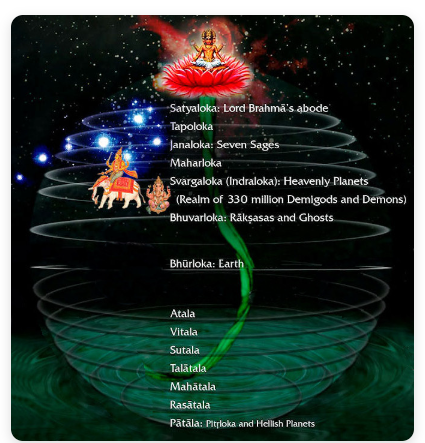
Canto 9, Chapter 4
SB 9.4
Liberation — Chapter 4
TEXT 1:Śukadeva Gosvāmī said: The son of Nabhaga named Nābhāga lived for a long time at the place of his spiritual master. Therefore, his brothers thought that he was not going to become a gṛhastha and would not return. Consequently, without providing a share for him, they divided the property of their father among themselves. When Nābhāga returned from the place of his spiritual master, they gave him their father as his share.TEXT 2:Nābhāga inquired, “My dear brothers, what have you given to me as my share of our father’s property?” His elder brothers answered, “We have kept our father as your share.” But when Nābhāga went to his father and said, “My dear father, my elder brothers have given you as my share of property,” the father replied, “My dear son, do not rely upon their cheating words. I am not your property.”TEXT 3:Nābhāga’s father said: All the descendants of Aṅgirā are now going to perform a great sacrifice, but although they are very intelligent, on every sixth day they will be bewildered in performing sacrifice and will make mistakes in their daily duties.TEXT 4:TEXT 5:TEXT 6:Thereafter, while Nābhāga was accepting the riches, a black-looking person from the north came to him and said, “All the wealth from this sacrificial arena belongs to me.”TEXT 7:Nābhāga then said, “These riches belong to me. The great saintly persons have delivered them to me.” When Nābhāga said this, the black-looking person replied, “Let us go to your father and ask him to settle our disagreement.” In accordance with this, Nābhāga inquired from his father.TEXT 8:The father of Nābhāga said: Whatever the great sages sacrificed in the arena of the Dakṣa-yajña, they offered to Lord Śiva as his share. Therefore, everything in the sacrificial arena certainly belongs to Lord Śiva.TEXT 9:Thereupon, after offering obeisances to Lord Śiva, Nābhāga said: O worshipable lord, everything in this arena of sacrifice is yours. This is the assertion of my father. Now, with great respect, I bow my head before you, begging your mercy.TEXT 10:Lord Śiva said: Whatever your father has said is the truth, and you also are speaking the same truth. Therefore, I, who know the Vedic mantras, shall explain transcendental knowledge to you.TEXT 11:Lord Śiva said, “Now you may take all the wealth remaining from the sacrifice, for I give it to you.” After saying this, Lord Śiva, who is most adherent to the religious principles, disappeared from that place.TEXT 12:If one hears and chants or remembers this narration in the morning and evening with great attention, he certainly becomes learned, experienced in understanding the Vedic hymns, and expert in self-realization.TEXT 13:From Nābhāga, Mahārāja Ambarīṣa took birth. Mahārāja Ambarīṣa was an exalted devotee, celebrated for his great merits. Although he was cursed by an infallible brāhmaṇa, the curse could not touch him.TEXT 14:King Parīkṣit inquired: O great personality, Mahārāja Ambarīṣa was certainly most exalted and meritorious in character. I wish to hear about him. How surprising it is that the curse of a brāhmaṇa, which is insurmountable, could not act upon him.TEXT 15:TEXT 16:TEXT 17:Mahārāja Ambarīṣa was a great devotee of the Supreme Personality of Godhead, Vāsudeva, and of the saintly persons who are the Lord’s devotees. Because of this devotion, he thought of the entire universe as being as insignificant as a piece of stone.TEXT 18:TEXT 19:TEXT 20:TEXT 21:In performing his prescribed duties as king, Mahārāja Ambarīṣa always offered the results of his royal activities to the Supreme Personality of Godhead, Kṛṣṇa, who is the enjoyer of everything and is beyond the perception of material senses. He certainly took advice from brāhmaṇas who were faithful devotees of the Lord, and thus he ruled the planet earth without difficulty.TEXT 22:In desert countries where there flowed the river Sarasvatī, Mahārāja Ambarīṣa performed great sacrifices like the aśvamedha-yajña and thus satisfied the master of all yajñas, the Supreme Personality of Godhead. Such sacrifices were performed with great opulence and suitable paraphernalia and with contributions of dakṣiṇā to the brāhmaṇas, who were supervised by great personalities like Vasiṣṭha, Asita and Gautama, representing the king, the performer of the sacrifices.TEXT 23:In the sacrifice arranged by Mahārāja Ambarīṣa, the members of the assembly and the priests [especially hotā, udgātā, brahmā and adhvaryu] were gorgeously dressed, and they all looked exactly like demigods. They eagerly saw to the proper performance of the yajña.TEXT 24:The citizens of the state of Mahārāja Ambarīṣa were accustomed to chanting and hearing about the glorious activities of the Personality of Godhead. Thus they never aspired to be elevated to the heavenly planets, which are extremely dear even to the demigods.TEXT 25:Those who are saturated with the transcendental happiness of rendering service to the Supreme Personality of Godhead are uninterested even in the achievements of great mystics, for such achievements do not enhance the transcendental bliss felt by a devotee who always thinks of Kṛṣṇa within the core of his heart.TEXT 26:The king of this planet, Mahārāja Ambarīṣa, thus performed devotional service to the Lord and in this endeavor practiced severe austerity. Always satisfying the Supreme Personality of Godhead by his constitutional activities, he gradually gave up all material desires.TEXT 27:Mahārāja Ambarīṣa gave up all attachment to household affairs, wives, children, friends and relatives, to the best of powerful elephants, to beautiful chariots, carts, horses and inexhaustible jewels, and to ornaments, garments and an inexhaustible treasury. He gave up attachment to all of them, regarding them as temporary and material.TEXT 28:Being very pleased by the unalloyed devotion of Mahārāja Ambarīṣa, the Supreme Personality of Godhead gave the King His disc, which is fearful to enemies and which always protects the devotee from enemies and adversities.TEXT 29:To worship Lord Kṛṣṇa, Mahārāja Ambarīṣa, along with his queen, who was equally qualified, observed the vow of Ekādaśī and Dvādaśī for one year.TEXT 30:In the month of Kārtika, after observing that vow for one year, after observing a fast for three nights and after bathing in the Yamunā, Mahārāja Ambarīṣa worshiped the Supreme Personality of Godhead, Hari, in Madhuvana.TEXT 31:TEXT 32:TEXT 33:TEXT 34:TEXT 35:TEXT 36:After standing up to receive Durvāsā Muni, King Ambarīṣa offered him a seat and paraphernalia of worship. Then, sitting at his feet, the King requested the great sage to eat.TEXT 37:Durvāsā Muni gladly accepted the request of Mahārāja Ambarīṣa, but to perform the regulative ritualistic ceremonies he went to the river Yamunā. There he dipped into the water of the auspicious Yamunā and meditated upon the impersonal Brahman.TEXT 38:In the meantime, only a muhūrta of the Dvādaśī day was left on which to break the fast. Consequently, it was imperative that the fast be broken immediately. In this dangerous situation, the King consulted learned brāhmaṇas.TEXT 39:TEXT 40:TEXT 41:O best of the Kuru dynasty, after he drank some water, King Ambarīṣa, meditating upon the Supreme Personality of Godhead within his heart, waited for the return of the great mystic Durvāsā Muni.TEXT 42:After executing the ritualistic ceremonies to be performed at noon, Durvāsā returned from the bank of the Yamunā. The King received him well, offering all respects, but Durvāsā Muni, by his mystic power, could understand that King Ambarīṣa had drunk water without his permission.TEXT 43:Still hungry, Durvāsā Muni, his body trembling, his face curved and his eyebrows crooked in a frown, angrily spoke as follows to King Ambarīṣa, who stood before him with folded hands.TEXT 44:Alas, just see the behavior of this cruel man! He is not a devotee of Lord Viṣṇu. Being proud of his material opulence and his position, he considers himself God. Just see how he has transgressed the laws of religion.TEXT 45:Mahārāja Ambarīṣa, you have invited me to eat as a guest, but instead of feeding me, you yourself have eaten first. Because of your misbehavior, I shall show you something to punish you.TEXT 46:As Durvāsā Muni said this, his face became red with anger. Uprooting a bunch of hair from his head, he created a demon resembling the blazing fire of devastation to punish Mahārāja Ambarīṣa.TEXT 47:Taking a trident in his hand and making the surface of the earth tremble with his footsteps, that blazing creature came before Mahārāja Ambarīṣa. But the King, upon seeing him, was not at all disturbed and did not move even slightly from his position.TEXT 48:As fire in the forest immediately burns to ashes an angry snake, so, by the previous order of the Supreme Personality of Godhead, His disc, the Sudarśana cakra, immediately burnt to ashes the created demon to protect the Lord’s devotee.TEXT 49:Upon seeing that his own attempt had failed and that the Sudarśana cakra was moving toward him, Durvāsā Muni became very frightened and began to run in all directions to save his life.TEXT 50:As the blazing flames of a forest fire pursue a snake, the disc of the Supreme Personality of Godhead began following Durvāsā Muni. Durvāsā Muni saw that the disc was almost touching his back, and thus he ran very swiftly, desiring to enter a cave of Sumeru Mountain.TEXT 51:Just to protect himself, Durvāsā Muni fled everywhere, in all directions — in the sky, on the surface of the earth, in caves, in the ocean, on different planets of the rulers of the three worlds, and even on the heavenly planets — but wherever he went he immediately saw following him the unbearable fire of the Sudarśana cakra.TEXT 52:With a fearful heart, Durvāsā Muni went here and there seeking shelter, but when he could find no shelter, he finally approached Lord Brahmā and said, “O my lord, O Lord Brahmā, kindly protect me from the blazing Sudarśana cakra sent by the Supreme Personality of Godhead.”TEXT 53:TEXT 54:TEXT 55:When Durvāsā, who was greatly afflicted by the blazing fire of the Sudarśana cakra, was thus refused by Lord Brahmā, he tried to take shelter of Lord Śiva, who always resides on his planet, known as Kailāsa.TEXT 56:Lord Śiva said: My dear son, I, Lord Brahmā and the other demigods, who rotate within this universe under the misconception of our greatness, cannot exhibit any power to compete with the Supreme Personality of Godhead, for innumerable universes and their inhabitants come into existence and are annihilated by the simple direction of the Lord.TEXT 57:TEXT 58:TEXT 59:TEXT 60:Thereafter, being disappointed even in taking shelter of Lord Śiva, Durvāsā Muni went to Vaikuṇṭha-dhāma, where the Supreme Personality of Godhead, Nārāyaṇa, resides with His consort, the goddess of fortune.TEXT 61:Durvāsā Muni, the great mystic, scorched by the heat of the Sudarśana cakra, fell at the lotus feet of Nārāyaṇa. His body trembling, he spoke as follows: O infallible, unlimited Lord, protector of the entire universe, You are the only desirable objective for all devotees. I am a great offender, my Lord. Please give me protection.TEXT 62:O my Lord, O supreme controller, without knowledge of Your unlimited prowess I have offended Your most dear devotee. Very kindly save me from the reaction of this offense. You can do everything, for even if a person is fit for going to hell, You can deliver him simply by awakening within his heart the holy name of Your Lordship.TEXT 63:The Supreme Personality of Godhead said to the brāhmaṇa: I am completely under the control of My devotees. Indeed, I am not at all independent. Because My devotees are completely devoid of material desires, I sit only within the cores of their hearts. What to speak of My devotee, even those who are devotees of My devotee are very dear to Me.TEXT 64:O best of the brāhmaṇas, without saintly persons for whom I am the only destination, I do not desire to enjoy My transcendental bliss and My supreme opulences.TEXT 65:Since pure devotees give up their homes, wives, children, relatives, riches and even their lives simply to serve Me, without any desire for material improvement in this life or in the next, how can I give up such devotees at any time?TEXT 66:As chaste women bring their gentle husbands under control by service, the pure devotees, who are equal to everyone and completely attached to Me in the core of the heart, bring Me under their full control.TEXT 67:My devotees, who are always satisfied to be engaged in My loving service, are not interested even in the four principles of liberation [sālokya, sārūpya, sāmīpya and sārṣṭi], although these are automatically achieved by their service. What then is to be said of such perishable happiness as elevation to the higher planetary systems?TEXT 68:The pure devotee is always within the core of My heart, and I am always in the heart of the pure devotee. My devotees do not know anything else but Me, and I do not know anyone else but them.TEXT 69:O brāhmaṇa, let Me now advise you for your own protection. Please hear from Me. By offending Mahārāja Ambarīṣa, you have acted with self-envy. Therefore you should go to him immediately, without a moment’s delay. One’s so-called prowess, when employed against the devotee, certainly harms he who employs it. Thus it is the subject, not the object, who is harmed.TEXT 70:For a brāhmaṇa, austerity and learning are certainly auspicious, but when acquired by a person who is not gentle, such austerity and learning are most dangerous.TEXT 71:O best of the brāhmaṇas, you should therefore go immediately to King Ambarīṣa, the son of Mahārāja Nābhāga. I wish you all good fortune. If you can satisfy Mahārāja Ambarīṣa, then there will be peace for you.